
Humanity's Place Between Heaven and Earth
I ChingThis flow traces the appendixes' effort to place human conduct within patterns of heaven and earth, while Legge questions later metaphysical claims.
increasing Bearing strength in each event
 decreasing
Bearing strength in each eventdecreasingThe Diagrams Mirror the World
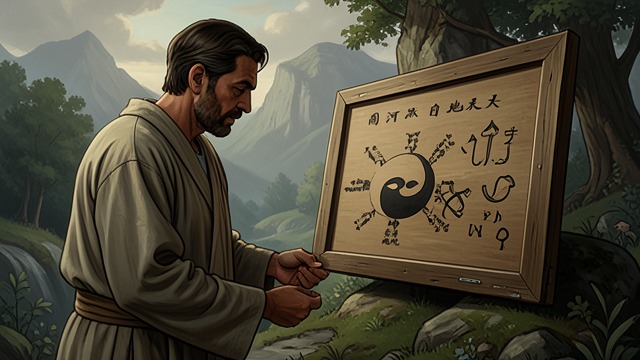
Natural Forms Become Symbols
Looking at the world
The Great Treatise says that ancient sages examined the sky, earth, animals, and human life before making the trigrams. The diagrams are presented as representations of nature's patterns.
Legge reports the account while questioning how it explains the exact forms.
Symbolic reach
The claim gives the diagrams a broad scope: natural phenomena and human affairs can both be considered through them.
The theme begins with a proposed correspondence between the world and its symbolic representation.
Heaven and Earth Produce Change
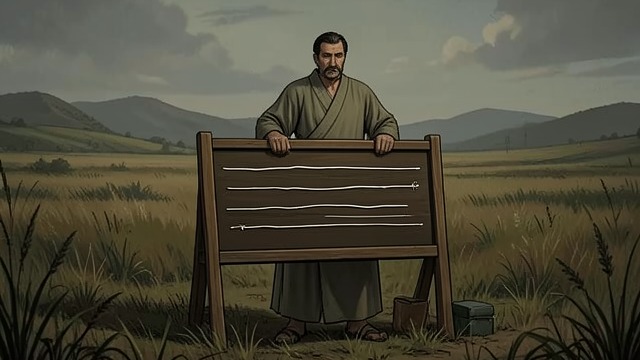
Change as Continuing Production
No fixed emptiness
The Great Treatise defines change as production and reproduction. Legge explains the idea through the replacement of what has been displaced and through the alternating movement of strong and weak lines.
Change is a process rather than an exceptional interruption.
Nature and society correspond
The appendix claims that the Changes accord with heaven and earth and show their course without confusion. Legge recognizes the force of the analogy while distinguishing it from proof of a cosmic mechanism.
The theme joins natural transformation to the experience of human affairs.
The Sage Acts With Circumstance
Knowledge Without Anxiety
A responsive intelligence
The Great Treatise portrays the sage as understanding many things, helping those under heaven, and acting according to the demands of circumstances. Legge finds the language extravagant but informative about the appendix's ideals.
The sage's virtue lies in timely adaptation.
Humanity within a larger order
The sage rejoices in Heaven's decrees while resting in his current position and cherishing benevolence. The text connects ethical life to an order beyond individual desire.
The theme makes human excellence a form of harmony, not mastery over nature.
God's Work Moves Through the Year
Nature as a Sacred Process
A sequence of trigrams
One appendix describes God moving through the trigrams as the year progresses from spring toward winter. Legge compares its emphasis on seasonal renewal to English poetry about the year.
The passage makes natural change a sign of divine activity.
The Spirit in things
Another paragraph describes Spirit as the subtle presence and operation of God with all things. Legge sees a powerful theological statement in this account.
The theme gives nature religious meaning without claiming that every later cosmology belongs to the original text.
Legge Separates Correlation From Science
A Boundary Around Cosmology
Correspondence is not prediction
Legge accepts that later readers see correspondences between diagrams and natural change. He rejects claims that the figures contain all truths later discovered by Western science.
The correspondence may illuminate an interpretive system without functioning as a body of physics.
Metaphysics has a history
He argues that doctrines such as the Great Ultimate belong to later development rather than the core text. Historical distinctions prevent later theories from being projected backward.
The theme resolves through critical separation, not a denial that the appendixes contain significant thought.
In the Great Treatise's account of origins
In the Great Treatise's definition of change
In the Great Treatise's portrait of the sage
In the appendix's account of seasonal progress
During Legge's analysis of the appendixes
